
RLEP is sponsoring a talk on Bears at 2:00 PM, Sunday, February 17th at the Theater in Washington, VA. Experts will discuss recently concluded studies on bear populations and management in Virginia, as well as tips and information on Living with Bears. A great presentation followed by question and answer period, just in time for the Spring Awakening! Admission is free. Contact RLEP at 540-675-RLEP, This email address is being protected from spambots. You need JavaScript enabled to view it.
CONSERVATION EDUCATION IN RAPPAHANNOCK COUNTYDid you know that your contributions to RLEP help to afford local fifth through twelfth grade student's the opportunity to attend Nature Camp in Vesuvius, VA? In 2012 RLEP sponsored one of Rappahannock's sixth graders with a scholarship to attend this two week academic and recreational camp that emphasizes education in natural history and environmental studies. After hearing his enthusiastic response to the program, the board has again voted to award a scholarship for 2013, this time to a qualified 7th grade applicant. The nature camp program has been operating for 70 years with the support of local garden clubs and community organizations. It is a 2 week overnight camp experience which strives to offer a rewarding educational experience of exceptional quality at the lowest possible cost.A second way that RLEP promotes environmental education is through donations to our local Rappahannock County Nature Camp. This is a 2 week long day camp along the Hazel River that accommodates younger campers and provides hand's on experiences in the natural sciences.By supporting these educational opportunities we hope to reconnect our children to the natural world and build a greater understanding of the ecology of Virginia. Perhaps we can influence a few budding scientists as well!
Those of you familiar with the Farm at Sunnyside know we actively maintain a conservation program to monitor and improve environmental health on the farm. Many of our neighbors and CSA members have expressed an interest in taking similar action on their own properties. Starting this month we will begin offering periodic workshops to teach people to do just that. Whether assessing water quality, establishing native grass meadows, building a vernal pool or identifying native or invasive plants, our goal is to provide you with the know-how and resources you need to better track and improve environmental conditions on your land.
The topic of our first workshop will be assessing stream health using bioindicators, namely salamanders and macroinvertebrates. This is an approach anyone can use to examine the health of their own streams without the need for expensive technology. After a general introduction to the topic, we’ll head out and examine two sites on the farm. We’ll sample for salamanders and other critters learning how to employ various techniques and equipment, identify the specimens we’ve collected and then interpret the results. Ensuring water quality is one of the most important things you can do as a Rappahannock landowner both for your benefit and for those living downstream. This workshop will help you achieve this goal while learning about the diverse, beautiful and seldom seen creatures that inhabit our local streams.
The cost is $40/person and $30 for CSA members which goes to support the farm’s environmental conservation program. To reserve a place or to learn more, please contact Sam Quinn at This email address is being protected from spambots. You need JavaScript enabled to view it. or by phone at 845-239-1297. Hope to see you on the 27th!
Spring salamander (Gyrinophilus porphyriticus)

RLEP invites you to attend the 42nd Annual Members Meeting on Friday, Nov 9, 6:30-9:00 PM at Rappahannock Cellars.
Light fare, cheeses and sweets will be served along with Rappahannock Cellars finest.
Members and prospective members are invited.
By Bud Meyer
The enemy goes by deceptively pleasing names: tree-of-heaven, autumn olive, mile-a-minute, multiflora rose, wineberry and Japanese stiltgrass.
But in the war on invasive species, far harsher terms describe what it takes to keep these invaders at bay: Hack and squirt. Kill it first. Go after the females. Manage the big thugs. Burn the field.
The key to victory?
“Have patience,” said Amissville’s Bryan Lilly, a habitat management specialist and a presenter at a Saturday morning workshop staged by the Rappahannock League for Environmental Protection. “Anytime you’re dealing with invasives, you’ve got to have patience.”
An engaged crowd showed up at The Theater in the town of Washington on a cool, drippy Saturday (July 21) morning for presentations by a pair of front-line habitat experts. The workshop included a muddy-boots tour of the town’s demonstration butterfly trail led by master naturalists Jack Price and Jenny Fitzhugh.

L to R - Jack Price, MN - Master Naturalist, Brian Morse, Jenny Fitzhugh (MN), Bryan Lilly, and Sam Quinn
While the Piedmont is home to diverse native plant life, unwelcome invasive species are the bullies on the block, pushing out natives and compromising local fields, forests and gardens. Removal is costly, time-consuming and darn-near impossible, even for backyard gardeners.
But both speakers said control is both possible and practical.
Lilly, a certified arborist and owner of Natural Elements, drew on seven years of plant management at the National Zoo to describe the worst of the unwelcome visitors.
Part of the problem is that invasive species come in all shapes and sizes. There are annuals like mile-a-minute and Japanese stiltgrass, biannuals like garlic mustard, herbaceous perennials and woodier foes like ailanthis (also called tree-of-heaven) and autumn olive. Each requires different techniques and seasons for removal. It’s not as simple as getting out the chain saw.
“You can cut ailanthis, cut it down, and it comes back 10 times worse,” said Lilly. “You’ve gotta kill it first.”
Brian Morse, a wildlife biologist working with the Virginia Forestry & Wildlife Group, agreed, calling ailanthis “the worst invasive tree species in Virginia.” In Rappahannock, Morse also sees autumn olive, multiflora rose, bittersweet and Japanese barberry “on every property.”
Morse showed selected case studies of efforts to remove such invasives as fescue and Johnson grass and replace them with native plants and grasses. He advises clients to decide what their land-use goals are first and take a phased approach.
Effective removal often comes down to patient, hands-on work, careful spraying with herbicides like glyphosate or Garlon, and knowing what sprays work when.
Morse offers these tips for clients:
- Scout for problems.
- Manage expectations.
- Be patient and persistent.
- Decide what really bothers you.
- Use adaptive management and long-term thinking.
The newest secret weapon in the war, according to Morse?
“Goats!” said Morse, showing a slide and drawing a laugh. In fact, he’s experimenting with using goats in prescribed grazing to help control invasives. (You do have to be prepared to look after it though).
A good resource for information on invasive plants and insects, Morse said, is www.invasive.org.
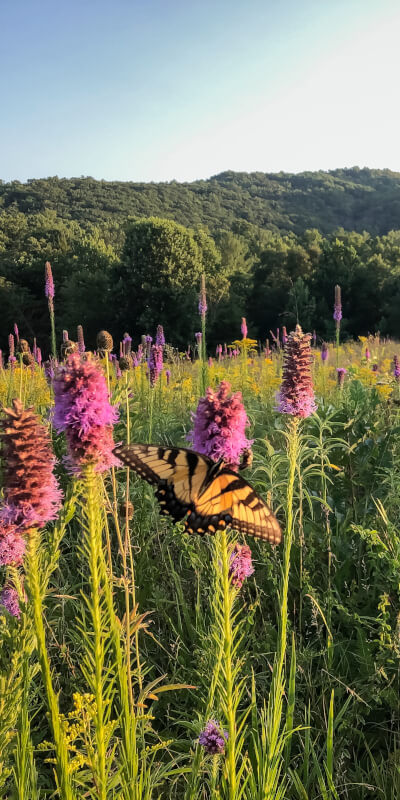
The butterfly trail project tour gave the appreciative crowd an up-close look at the newly planted host and nectar plants used to draw butterflies in the gardens near Avon Hall. Price and Fitzhugh described plans for careful removal of nearby tree-of-heaven, autumn olive and Japanese stiltgrass to make way for natives.

The invasive species workshop is the third in RLEP’s education series this year. Previous workshops featured naturalist Bruce Jones and a presentation on ticks and Lyme disease. This fall, RLEP plans a program on bears.
RESOURCES
- A Management Guide for Invasive Plants in Southern Forests
- Virginia Department of Forestry
- The Nature Conservancy
- The Virginia Dept of Conservation and Recreation - in the left hand column, pull down: Natural Heritage to find more.
- The Natural Resource Conservation Service (NRCS)- look for cost sharing funding for invasive species removal through the EQIP program.